Realistic Digital Detox Plan: Weekend, 7 or 30-Day Challenge
A realistic digital detox plan for this weekend, step by step, plus a 7-day reset and a 30-day challenge that cut scrolling without cutting you off.
A realistic digital detox cuts the scrolling, not your whole life. If you have a weekend, use the two-day plan below: a 15-minute setup on Friday, a phone-free Saturday morning, a feed-free Sunday and a short review. Then the 7-day reset and 30-day extension make it stick. You keep messages, maps and calls the whole way through.
Quick answer
- This weekend: set up on Friday night, no phone for Saturday morning, social apps blocked on Sunday, a 10-minute review on Sunday evening.
- Days 1 to 7: notifications, home screen, grayscale, a replacement, phone-free zones, one hard limit, review.
- Weeks 2 to 4: phone-free mornings and nights, one feed-free day a week, tighter limits.
- The key: a limit on your worst app that you can't dismiss in one tap.
Why do most digital detox challenges fail?
Because they are framed as deprivation, and deprivation triggers rebound. "No phone at all" turns an ordinary tool into forbidden fruit. The craving spikes, you cave, and you feel like a failure, even though the plan was never realistic.
Two myths make it worse:
- The "dopamine reset". You can't drain and refill dopamine like a battery over a weekend. What changes during a detox is your habits and the cues that trigger them.
- Cold turkey. 48 hours off-grid feels virtuous but teaches your brain nothing about an ordinary Tuesday. That's why the weekend plan below keeps your phone for the useful things and ends with one rule you carry into the week.
The average person spends over four hours a day on their phone; our screen time statistics put your number in context. The aim isn't zero. It's getting those hours back under your control.
What's a realistic digital detox plan for this weekend?
Two days won't rewire a habit, but they show you where your time goes. The trick is to block the scrolling, not the phone.
Friday evening (15 minutes)
- Turn off every notification except messages from real people.
- Move social and video apps into a folder on your last home screen page.
- Pick your keepers: messages, maps, music, camera. Everything else waits.
- Tell the one or two people who'll worry that you'll reply slowly.
- Set the block once, so the weekend doesn't run on willpower. In the Detox app, add a Schedule for your social and video apps from Saturday 9 a.m. to Sunday 9 p.m. and turn on Strict Mode, so you can't edit it halfway through. Apple's Screen Time Schedule works too, but you can lift it in a tap.
- On your computer, the Detox Chrome extension (free) hides YouTube Shorts, Reels and endless feeds, and can block any site you add for the weekend.
- Charge your phone outside the bedroom and set a real alarm clock if you have one.
Saturday
- No phone for the first hour after waking. Have breakfast, go outside.
- Plan one offline block: a walk, a market, sport, a friend.
- Check messages at set times, say noon and 6 p.m., not whenever.
- Phone in another room during meals.
Sunday
- Same morning rule.
- Feed-free day: social and video apps stay blocked from morning to night.
- Do one slow thing you keep putting off: cook, read, call someone.
- In the evening, take 10 minutes. Compare your screen time with last weekend, note what you missed and what you didn't.
Monday: keep one rule from the weekend. It becomes Day 1 of the 7-day plan below.
If a block slips, check why a Screen Time schedule can fail.
What's the 7-day digital detox challenge?
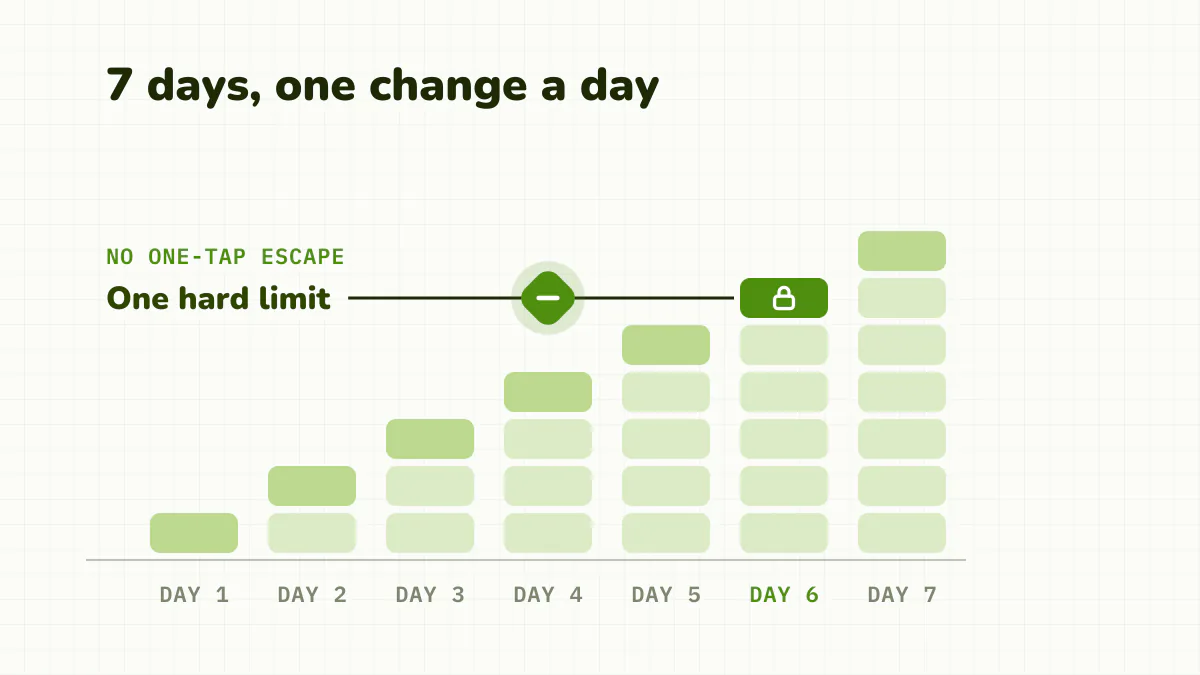
Each day adds one change, in order of impact. They stack: Day 3 keeps everything from Days 1 and 2.
| Day | Focus | What you do |
|---|---|---|
| 1 | Notifications | Turn off every non-essential notification. Keep messages from real people; kill social, news, games and promos. |
| 2 | Home screen | Move time-sink apps into a folder on the last page. Three seconds of friction between urge and open. |
| 3 | Grayscale | Switch the screen to black and white. Bright colors and red badges are built to grab you. |
| 4 | A replacement | Put a real alternative within reach: a book on the nightstand, a podcast, a notebook. |
| 5 | Phone-free zones | Pick two. The dinner table and the bedroom are the best. |
| 6 | One hard limit | A real barrier on your single worst app, not a reminder you can swipe away. |
| 7 | Review | Compare your screen time to Day 0. Note what was hardest and what you didn't miss. |
Notifications come first because every ping is an invitation back in. If you only manage the first three days, you will still feel a shift.
What to expect: Days 1 to 3 are the hardest. You reach for the phone on reflex and the friction annoys you, which is the sign it's working. By Days 4 to 7 the reflex fades and you notice quiet moments you would have filled. Here are things to do instead of scrolling when the itch hits.
How do you extend it to 30 days?
Week 1 breaks the reflexes; the rest of the month makes the new normal automatic. Keep everything from Week 1 and add one habit per week.
- Week 1: Reset. Run the 7-day plan. Add nothing; hold the line.
- Week 2: Protect the edges of your day. No phone in the first hour after waking or the last hour before bed. These two windows hurt attention and sleep the most. See our no-phone-before-bed routine.
- Week 3: One feed-free day. Pick a day, Sunday works well, where social apps stay blocked from morning to night. You keep maps, messages and music.
- Week 4: Tighten the limits. You now know which app still pulls you in. Shorten its limit and hold it.
By the end of the month, your phone is a tool you pick up on purpose again instead of a reflex you fall into.
How do you make the limits actually stick?
This is where every honest detox hits the same wall. Apple Screen Time is fine for nudges, but it is built to be dismissed. At 11 p.m., "Ignore Limit" is one tap away, and at 11 p.m. you will tap it.
Detox (iOS, paid with a free trial) is built for that gap. Its session limit lets quick checks through, but once you have scrolled the chosen apps continuously past your limit, they lock for a short break while the apps you rely on stay open. Schedules cover your phone-free mornings and evenings, and Block now locks apps instantly. There is no one-tap escape, which is why a detox holds past Day 3.
On Android the same principles apply; you'll just need a different tool to enforce them.
What if you relapse partway through?
You will, and it's normal. One bad evening isn't a failed detox. Going from four hours of scrolling to ninety minutes is a huge win even with a few slips.
If you can't stop even when you want to, or feel real anxiety without your phone, read our guide to phone addiction, which has a quick self-test. If scrolling itself is the sticking point, the how to stop scrolling method breaks it down step by step.
The bottom line
Treat the challenge as design, not deprivation. Run the 7-day reset one change at a time, stretch it to 30 days, and put a hard-to-dismiss limit on your worst app. You're not quitting your phone. You're taking back the hours it was quietly taking.
Frequently asked questions
What is a digital detox challenge?
A set period, usually 7 or 30 days, where you cut compulsive phone use one step at a time. The goal is to drop the mindless scrolling and keep the useful parts: messages, maps and calls.
How long should a digital detox be?
Start with 7 days to break the reflexes, then extend to 30 to make new habits stick. Most people feel a difference within 3 to 7 days; rewiring the habit takes about 3 to 4 weeks.
Can you do a digital detox in one weekend?
Yes, as a start. A weekend is enough to notice how often you reach for your phone and what you don't miss. It won't rewire the habit on its own, so end it with one rule you keep on Monday.
Does a digital detox actually work?
Yes, when it is about reduction rather than total deprivation. Cold-turkey detoxes rely on willpower against apps built to pull you back; a gradual plan changes your environment instead.
Do I have to give up social media entirely?
No. You keep what serves you, like messaging friends, and cut the hours-long scrolling. Deprivation triggers rebound; reduction sticks.